
They say that only memories that touch our hearts go with us when we leave this body, and if you listen with your heart, those memories return. When we mention the blood that flows through our veins, we automatically think of our ancestors, as if there is a genetic code passed down through the bloodline.
My memories often lead me to one of Rumi’s quotes:
“Essentially, your soul and my soul are the same; we appear together, then disappear.”
I often remember the story my late father told me.
A long time ago, in the year fifteen hundred and something, three brothers from the Korkut family arrived at the Blagaj Tekke. They were dervishes, sufis. They came from Konya, traveling who knows how long, with the intention of conveying the message of their teacher, Sheikh Jalal ad-Din Muhammad Rumi, known as Mevlana. They were dervishes, mevlevi, as they were called here, and they danced in Zikr, unlike other dervish orders, and their message was, and still is, a message of the heart. In their message, there was no fear of being consumed, of being worn out, as Rumi himself said:
“If one candle lights another candle, it will lose nothing of its light.”
The brothers liked the place where they had come, and how could they not, so they stayed forever in Blagaj, and their dance in Zikr is still recognizable in the walls, as if they are still dancing. Luckily for me, one of them saw a beautiful girl from Herzegovina walking down the Buna River. And when he saw her, he was sure he had come home. He fathered two children, and then those children had children, and their children… And as he was literate, he left his mark both on paper and, of course, in the hearts of their children. So here I am writing as well, so that a mark remains on paper, or rather on the computer, even though I know that memories that touch the heart will never disappear. I go to the Blagaj Tekke and invite guests as if to my own home. A home of human hearts that still remember how Mevlana spoke, and there I also remember my father and my fathers’ fathers, and my heart leaps when I think of whose blood flows through my veins. So, I want to share a memory of one of the Korkuts, who did not forget his genetic code even when it was hardest.
“Even a tear has its duty.
Its duty is to clear the ground for the smile that comes after it.”
Rumi
Dervish Korkut (1888-1969), son of Hadji Ahmed Munib Korkut and Shahida, born Biščević, from Travnik, was a librarian and curator of the National Museum, and a well-known orientalist. He studied at universities in Istanbul and Sorbonne. He published texts about minorities in Bosnia, Jews (Sarajevo Jews in the year 1848, antisemitism is foreign to Muslims in Bosnia and Herzegovina), and Albanians. He was a gentleman, an anti-fascist, an intellectual.
His brother Besim Korkut (1904-1975), an Arabist, made one of the first translations of the Quran into the then-official Serbian-Croatian language.

The German army occupied Sarajevo on April 16, 1941, and early the following year, General Johan Fortner stormed the National Museum and demanded that its director, Joza Petrović, a well-known Croatian archaeologist, hand over the Sarajevo Haggadah. This book was intended to be a significant exhibit in the Jewish quarter of Prague, where everything that could be plundered in occupied Europe was envisioned to be gathered to create a tourist attraction for “Aryan” visitors, under the title Jewish City, a caricatural museum of an exterminated people. This concept of Adolf Hitler was implemented by Alfred Rosenberg, the Minister of Eastern Territories. The collection was planned to be the foundation of a new scientific discipline, Judenforschung ohne Juden (Jewish Studies without Jews). In Nazi aesthetic terminology, there were specific terms, such as syphilitic art, a phrase used by Rosenberg to refer to Expressionism. The Nazis collected over thirty thousand exhibits for this grotesque idea, in which the Sarajevo Haggadah would be a significant trophy.
In such an atmosphere of occupied Europe, Derviš Korkut decided, with the consent of Joza Petrović, the then-director of the National Museum, to save the Sarajevo Haggadah. He remembered the scenes of the destruction of Torah scrolls on the streets of Sarajevo and wanted to ensure that the Haggadah would avoid a similar fate. Among researchers investigating the events surrounding the hiding of the Haggadah, there are various versions. Some claim that Petrović and Korkut agreed to hide the book in the basement among other books. Others suggest that Korkut eventually hid it outside the Museum. In any case, the Haggadah was preserved thanks to the determination and courage of the curator and the director. The decisions were mutual, but the action was exclusively Korkut’s. When General Fortner asked Director Petrović to hand over the famous book, Korkut said that two SS officers had already taken it. The general was furious and demanded the names of the officers. Derviš humbly replied, “Who am I to ask SS officers for their names?” The general then insisted on a receipt for the removal of the Haggadah: “A librarian like you wouldn’t have handed over the book without a receipt!” Derviš quickly ran to his office and wrote a receipt for the Haggadah’s pickup on a piece of paper, dating it from the previous week and scribbling an illegible signature in German. The general was furious but did not come into possession of the Haggadah and was later condemned for his actions during the war and hanged in 1947.
A good portion of the information about Korkut and his family was provided by the wife of the curator’s nephew, Hatima Korkut. She currently lives in Arlington, United States. She teaches the Bosnian language to officials in the Ministry of Foreign Affairs. The entire family is proud of Derviš, his encyclopedic education, and his bravery. He published two books on the history and architecture of Travnik and his memories (1961) and several other published works, including Turkish Love Songs in the anthology by the Dubrovnik native Miho Martelini from 1657, and a Turkish-Serbo-Croatian dictionary by an unknown author from the 17th century, among others. He was the editor of the Bulletin of the Islamic Community from its founding in January 1933 until 1936. He came from a Turkish family that settled in Bosnia in the 16th century.
Hatima Korkut mentioned to the author of the piece in The New Yorker that Derviš’s wife, Servet, still lives in Sarajevo. She was only 16 years old when she married in 1940. Her Albanian family from Kosovska Mitrovica opposed her marrying a much older man, but she went ahead with it. Džeraldina Bruks visited her. Servet claimed that Derviš brought the Haggadah home. That same day, he went to Visoko and then to Treskavica, where he hid the Haggadah with a hodža in a mosque, among the Qur’ans. After the war, the hodža returned the Haggadah to Derviš, who then returned it to the Museum. Servet could not name the hodža. From Derviš’s wife, Bruks learned that their son, Munib, lives in Paris, where he works as an engineer. She visited him to find out more details about the Korkut family and the rescue of the Haggadah. She made a completely new and unexpected discovery.
Korkut’s rescue of a Jewish girl
In April 1942, Derviš returned home early from the Museum once again. He brought with him a high school-aged girl. He told his wife that she was Jewish, named Mira Papo, and that her parents had been taken to a camp. Servet immediately accepted her. They dressed her as a Muslim, named her Amira, and said she was an Albanian sent by her relatives from Kosovska Mitrovica to help them at home. She and Mira became friends, as they were the same age. As the situation in Sarajevo became increasingly dangerous, Mira was moved to Dalmatia. Since she had been involved with Hašomer Hacair before the war, when the conditions were right, she joined the partisans.
Imprisonment in Zenica
After the war, Mira returned to Sarajevo. She was engaged to partisan officer Božidar Baković. In June 1946, she met a woman on the street who began begging her for help, as her husband was being tried as a collaborator with the occupiers. As a person fluent in several languages, they needed him to do translations, especially of German texts. Mira did not recognize Derviš’s wife Servet in the woman, with whom she had hidden during the war several years earlier. Derviš Korkut, just as he did not join fascist organizations during the war, also did not want to join the communist party. He was an anti-fascist, but that was not enough for the new regime, so he was sentenced to several years in prison, which he served in Zenica. Mira assured Servet that she would testify in favor of Derviš, but she did not appear in court. Later, she claimed that her fiancé, her future husband, dissuaded her from doing so. He said that, as a military figure, she should not appear as a witness in a politically motivated trial. The defendant was already condemned in advance, and she could not help him.
Bakotić died two years later. Mira was left with two minor sons, Daniel and Davor. After demobilization, she went through a tough period in her life. Although a convinced atheist, over time she remembered her Jewish roots, celebrating Hanukkah and other holidays. Davor met an Israeli, and as a result of their friendship, he moved to Israel in 1969 and settled in a kibbutz. His mother joined him three years later. In 1978, they moved to Jerusalem.
During the Bosnian Jews’ exodus in 1992, Mira came across some newspapers that wrote about Derviš Korkut, the man who saved her life. From the article, she learned that Korkut had not been killed, as she had thought, but had spent years in prison in Zenica and died of natural causes after being released from prison in 1969. Davor heard Derviš Korkut’s name for the first time from that article. Mira Papo decided to write her life story, detailing how the curator of the National Museum saved her during the war and how she missed the chance to testify in his favor after the war. She submitted her statement titled “How Derviš Efendi Korkut Saved Me from Certain Death” to Yad Vashem. Mira passed away in 1998, a year before Korkut was declared Righteous Among the Nations.
Servet Korkut learned that her husband had been declared Righteous while she was in Paris visiting her son Munib. The Israeli embassy awarded her a certificate of honor and a medal. Servet told Džeraldina that Mira once called her in Paris to explain her actions. The Albanian woman reassured her, saying that she didn’t believe her testimony would change the course of the trial. There were those who testified in favor of Derviš, but it did not help at all.
Derviš Korkut was sentenced to eight years in prison, of which he served six. Servet, then the wife of a national enemy, was left without a job and an apartment.
She went to her family in Kosovska Mitrovica with her son Munib and daughter Abida. At that time, there was a meningitis outbreak in Kosovska Mitrovica. Abida fell ill and soon died. Munib remembers how he and his mother traveled to Zenica once a week to visit Derviš. The journey took two days, and the visit was allowed for only five minutes. Derviš was released from prison, but his civil rights were never restored. He and Servet had a daughter, Lamija, in 1955. She was fourteen years old when her father died. She remembers how people spoke of him with respect, that he helped many and advised them. However, he never mentioned Mira Papo and how he saved her from certain death, just as Mira never mentioned him to her children. During the bombing of Sarajevo, Lamija managed to leave the city in a convoy with Jews. She moved to Priština with her Albanian husband’s family, an electrical engineer. In March 1999, during the NATO bombing, Servet was visiting her daughter. Lamija and her husband spent days trying to connect with relatives in Paris and Sweden by phone, to obtain a visa for some country through connections. Everything was in vain. With great difficulty, they reached Macedonia, where they stayed with relatives in Kumanovo. They again tried to plead with relatives and friends over the phone to obtain documents for them. At one point, Munib came up with the idea to contact the Jewish community in Skopje. He told Lamija to say there that their father was one of the Righteous Among the Nations because he saved a Jewish woman. Fortunately, she had a photocopy of the certificate from Yad Vashem and showed it to the authorities. The Jewish community in Skopje was proud to be able to help in the plight of the daughter of a Righteous person. In four days, they arrived in Tel Aviv. After that Balkan horror, the bright Mediterranean sun seemed unreal to them. Derviš Korkut, a Muslim, saved the Jewish woman Mira, and Lamija, his daughter, a Muslim, was overjoyed when Mira’s son, Davor Baković, welcomed them at Ben Gurion Airport.
The Sarajevo Haggadah is a miraculous book, an exception among Haggadahs. It does not only tell the story of the Exodus. It also has its liturgical part. Therefore, besides its exceptional aesthetic value of the illustrations, it possesses a moral lesson. The mystery of its journey from Spain to Sarajevo still needs to be explored. But it evidently has a magical influence on today’s events in our Balkan-Middle Eastern regions.
Geraldine Brooks, the author of the article in The New Yorker about the fate of the Sarajevo Haggadah and Derviš Korkut, is a well-known publicist and writer of historical novels. In January 2008, she published the book People of the Book, a fictionalized history of the Sarajevo Haggadah by the American publisher Viking. https://en.wikipedia.org/wiki/People_of_the_Book_(novel)
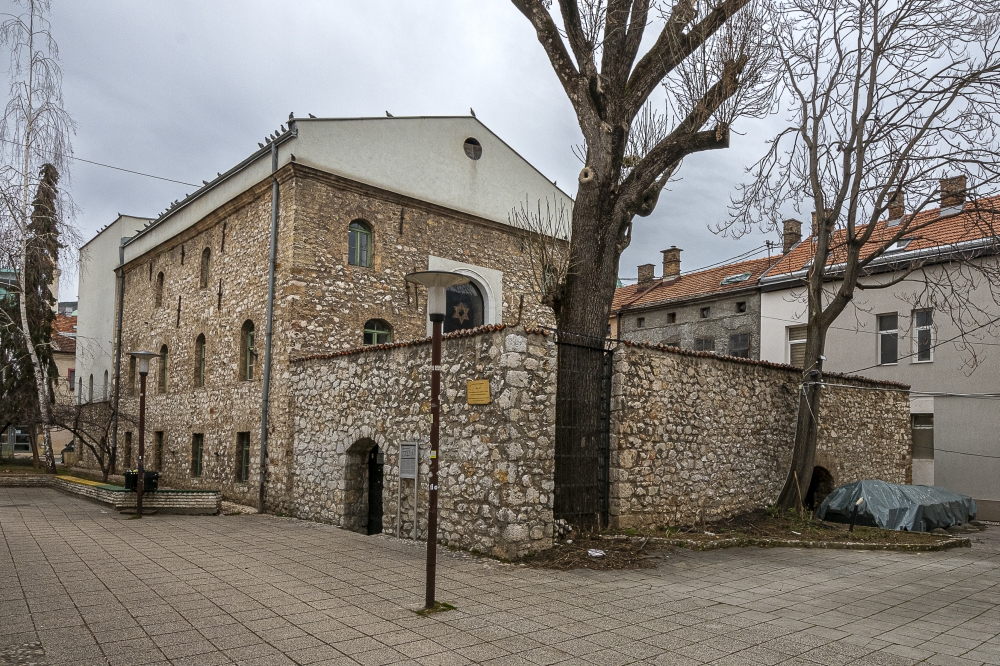
You can find their picture in the Museum of Jews in Bosnia and Herzegovina in Sarajevo, as well as in Yad Vashem, The World Holocaust Remembrance Center, Jerusalem: https://collections.yadvashem.org/en/righteous/4021797
 Želim da skrenem pažnju da smo postojali i prije nego sto smo postali srbi, muslimani, hrvati, bošnjaci i ostali. Bili smo jedan moćan narod sa svojim jezikom, znanjem, duhovnim školama, spomenicima i sjećanjima za koje nas ubjeđuju da su nešto drugo …
